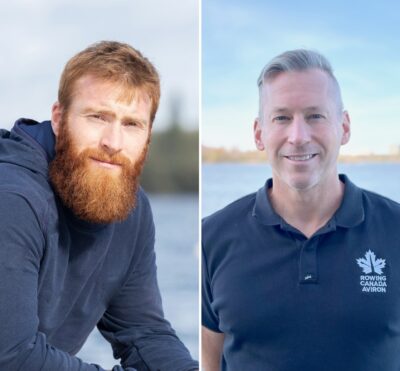
Rowing Canada Aviron Welcomes Dan Moore and David Robertson to Senior Leadership Team
- Rowing Canada Aviron
- Oct 22, 2026
Rowing Canada Aviron (RCA) is pleased to announce the appointment of Dan Moore as Director of Pathway and David Robertson as Director of Operations. Both are new positions on RCA’s Senior Leadership Team, created to strengthen the systems that connect Canadian athletes and coaches from community programs to the international podium, and to support the delivery of the organization’s strategic plan, Vision 2032.
“Dan and David each bring deep experience in high performance sport and a real understanding of what it takes to build systems that last,” said Jennifer Fitzpatrick, Chief Executive Officer of Rowing Canada Aviron. “Dan has developed rowers from their first strokes in talent identification and development programs all the way to the Olympic podium, and David has spent more than two decades strengthening the Canadian sport system as a coach, an executive director, and a national program leader. Together, they strengthen our leadership team at an important moment, helping us achieve our community development goals by growing the sport and expanding access across the country, while building a stronger pathway to the podium at LA28 and Brisbane 2032.”
Dan Moore, Director of Pathway
As Director of Pathway, Dan will lead RCA’s athlete and coach development pathway, bridging domestic and high performance programs, with a particular focus on high-potential development athletes and coaches, including NextGen. His portfolio also includes national competitions, aligning competition programming with athlete and coach development objectives.
Dan joins RCA from British Rowing, where he has worked since 2012. Since 2018, he has served as a High Performance Coach with the Olympic program. He coached the men’s double sculls at the Tokyo 2020 Olympic Games, then co-coached the men’s pair and four at the 2024 Paris Olympic Games, earning silver and bronze medals. Most recently, he coached the women’s four and women’s eight at the 2025 World Rowing Championships in Shanghai, earning a bronze medal and a fifth-place finish.
From 2012 to 2018, Dan served as a World Class Start Coach with British Rowing’s talent identification program, running school recruitment campaigns, leading a daily training squad, and identifying athletes who went on to reach junior and U23 World Championship podiums. He coached the women’s double sculls to U23 World Championship gold in Rotterdam in 2016.
Dan holds a Master of Research from St Mary’s University, where his research examined the physiological determinants of Olympic rowing medallists, and a Bachelor of Science in Sport and Exercise Science from Loughborough University.
“Canada has a great heritage in Olympic rowing, and I grew up watching some of the great crews of the 2000 era,” said Moore. “It’s clear there is a strong passion to develop performance on the water here, and I’m looking forward to learning about the strong Canadian rowing community and especially the coaches that glue the system together.”
David Robertson, Director of Operations
As Director of Operations, David will work closely with the CEO and Senior Leadership Team to align strategy with execution and strengthen RCA’s internal operations. He will provide leadership across Member Services, Human Resources, Communications, and Safe Sport, and contribute to funding, reporting, and risk management.
David brings more than 20 years of experience across the Canadian sport system, from grassroots participation to Olympic and Paralympic high performance. From 2023 to 2026, he served as High Performance Pursuit Advisor with Own the Podium, where he led a professional development program for Canada’s high performance coaches and technical leaders across summer, winter, Olympic, and Paralympic sport. From 2019 to 2023, David was a Sport Consultant, Excellence, and High Performance Coaching Lead with Sask Sport and the Canadian Sport Centre Saskatchewan. At the same time, he served as Executive Director of the Coaches Association of Saskatchewan, leading its strategic and operational management, including budgets, governance, and partnerships. He previously served as Executive Director of Canoe Kayak Saskatchewan, and in 2025 co-chaired the organizing committee for the Canoe Kayak Canada Sprint National Championships in Regina. David began his career as a coach at clubs in Canada and the USA and was a national team coach with Canoe Kayak Canada from 2010 to 2017. He has since volunteered in the sport as a club president, board member, official, and umpire. A Chartered Professional Coach and Advanced Coaching Diploma graduate, David holds a Bachelor of Kinesiology in Recreation and Sport Administration from the University of Regina, where he is completing a Master of Science in Kinesiology and Health Studies (Sport Management).
“This is a great time to be joining Rowing Canada Aviron, with real optimism across Canadian sport and a clear vision toward 2032,” said Robertson. “I’ve worked in water sports as a coach, official, club president, board member, and provincial director, and I’ve seen from every side how much strong systems matter to the people on and off the water. I’m excited to help build the operational foundation that will serve our athletes, coaches, umpires, and clubs for years to come.”
Dan and David report to RCA CEO Jennifer Fitzpatrick, alongside High Performance Director Adam Parfitt, Finance Manager Carla Soares, and Communications Lead Colleen Coderre.
Learn more about Rowing Canada Aviron’s Vision 2032 here.